Disney targets smelly little Latinos

buzzlight.jpg

You know how smelly children can get –especially if they are Hispanic. But thankfully there are marketers out there who never stop working to bring us the best of their market research translated into products we didn’t know we needed so bad.

So now, and after what seems to be yet another research breakthrough, Disney is launching Pirates of the Caribbean and Buzz Lightyear fragrances, targeting –who else?– Latino boys ages 4-11.

According to Brandweek, the new Disney fragrances will retail between $9.95 and $19.95 and will hit the shelves by September (mmm, just in time for Hispanic Heritage Month). And as it happens so often with these product launches, they are expected to fill an untapped market with “huge potential.” Or, as a Disney executive herself put it: “U.S. males are slower to get into the men’s fragrance arena than European, Latin [sic] and South American men.”

I don’t know about you, but I still remember the smell of my male companions in my Mexico City elementary school: a delicious blend of chalk, pencils, sweat and Pan Bimbo sandwiches. I am not sure my childhood memories would be as strong had they worn a Disney fragrance.

Hispanic marketing 101: what do to with “Chi-chis”

Hormel Foods has enrolled a bunch of marketing students from Chicago’s DePaul University to help find answers in how to market to Hispanic consumers.

According to –who else?– Pork News, 12 DePaul students were enlisted to analyze a dozen of Hormel brands that are not currently active in the Hispanic market and identify “growth opportunities.” This, of course, to give the kids a chance to prove their marketing skills. “We easily could have assigned this project to an established research company, but we wanted to see what these promising students could discover,” a Hormel executive said in a statement.

I have no idea what these kids came up with, but I can only hope they could talk the company into reconsidering the name of one of its most popular “ethnic” salsas: Chi-chi’s. Or, at the very least, recommend a more spicy –and suitable– pitch to make the most out of such a kinky brand. How about a celebrity spokesperson? (think Lorena Herrera, Verónica Castro or La Tetanic) And don’t worry if they are not real; the salsas are also pretty fake.

(And in case you don’t know what Chichis are, you can always click here).

I just write the stuff, don’t expect me to watch it

Ever wondered why Telemundo telenovelas have such a hard time beating those of Univision? For starters, Univision’s fare is mostly comprised by novelas imported directly from the mero-mero del drama, the so-called dream factory, her highness Grupo Televisa. But there’s also Telemundo’s insistence on producing its own shows, or as the network’s president likes to say (quite often) to control its own destiny.It was with this in mind that the NBC-owned network launched Taller Telemundo, a six-month program in partnership with Loyola Marymount University to “inspire, discover, recruit and train the next generation of fiction writers.”

Well, this week the workshop graduated its Class of 2007, a group of eight lucky hopeful writers. Among them, according to a story in Los Angeles Times, is Liliana Hung (right), a 35-year old Colombia-born mortgage banker who was selected from 1,500 applicants from around the world to write a 10-page telenovela script. Graduation doesn’t guarantee Liliana a writing gig at Telemundo, but her chances are obviously greater than the rest of us. Funnily enough, and as my friend from Clemenseando smartly pointed out, Hung admits to not watching a lot of Spanish-language television.

In fact, she says her favorite TV shows are Law and Order and Nip/Tuck. She grew up reading Mark Twain and watching M*A*S*H and The Streets of San Francisco.

Ay dios! I cannot wait to see what a Hung-authored telenovela will be all about.

At last! market research that makes sense

salmahayekscreenshot.jpg

I never thought I would ever be thankful to a market research firm, but this time I am … truly. So, thank you, E-Poll Market Research for giving curvy Latinas in our late (very late) 30s something to live for.

According to research released this week by the Encino, Calif.-based polling firm, Hollywood’s 15 sexiest celebrities are all curvy (very curvy) and over 36.

And, perhaps not surprisingly, topping the list is 40-year-old pregnant Mexican beauty Salma Hayek. (Truth be told, the average age was severely loaded given the fact that Raquel Welch was also among the top 15).

The polling company provides so-called “appeal rankings” for more than 3,000 celebrities (both men and women), and the results showed 65% of the U.S. population would use the term “sexy” to describe Salma, beating out Beyonce, Pamela Anderson, Hally Berry and other not-so-young beauties.

See? Maybe we’ll never be able to beat Brazil or Argentina in a soccer competition, but when it comes to beating anorexic white celebrities, Mexicans are a class of their own. And don’t get me started on the multimillionaires (Slim vs. Gates).

¡Sí se puede! ¡Sí se puede!

Mexican food for the uninitiated

rosendale.jpg

Funny things happen to Mexican food when it has to be explained to “unacculturated” gringos. And I can only applaud the creativity (I would even say, the poetry) behind some of those efforts.

The owners of Santa Fe restaurant in tiny Tarrytown, NY, pitch their eatery as the only place in town serving “authentic Mexican food” (i.e. no burritos, chili con carne and your Taco Bell-type fare). But serving the real thing has its challenges, especially when you have to deal with an overwhelmingly white crowd.

The owners of Santa Fe found a way around it and left things in a nondescript manner for the uninitiated: cochinita pibil becomes “Mayan Barbecue,” in the English-language portion of the menu, while menudo is merely described as a “delicious Mexican spicy soup” (no word on the tripes.)

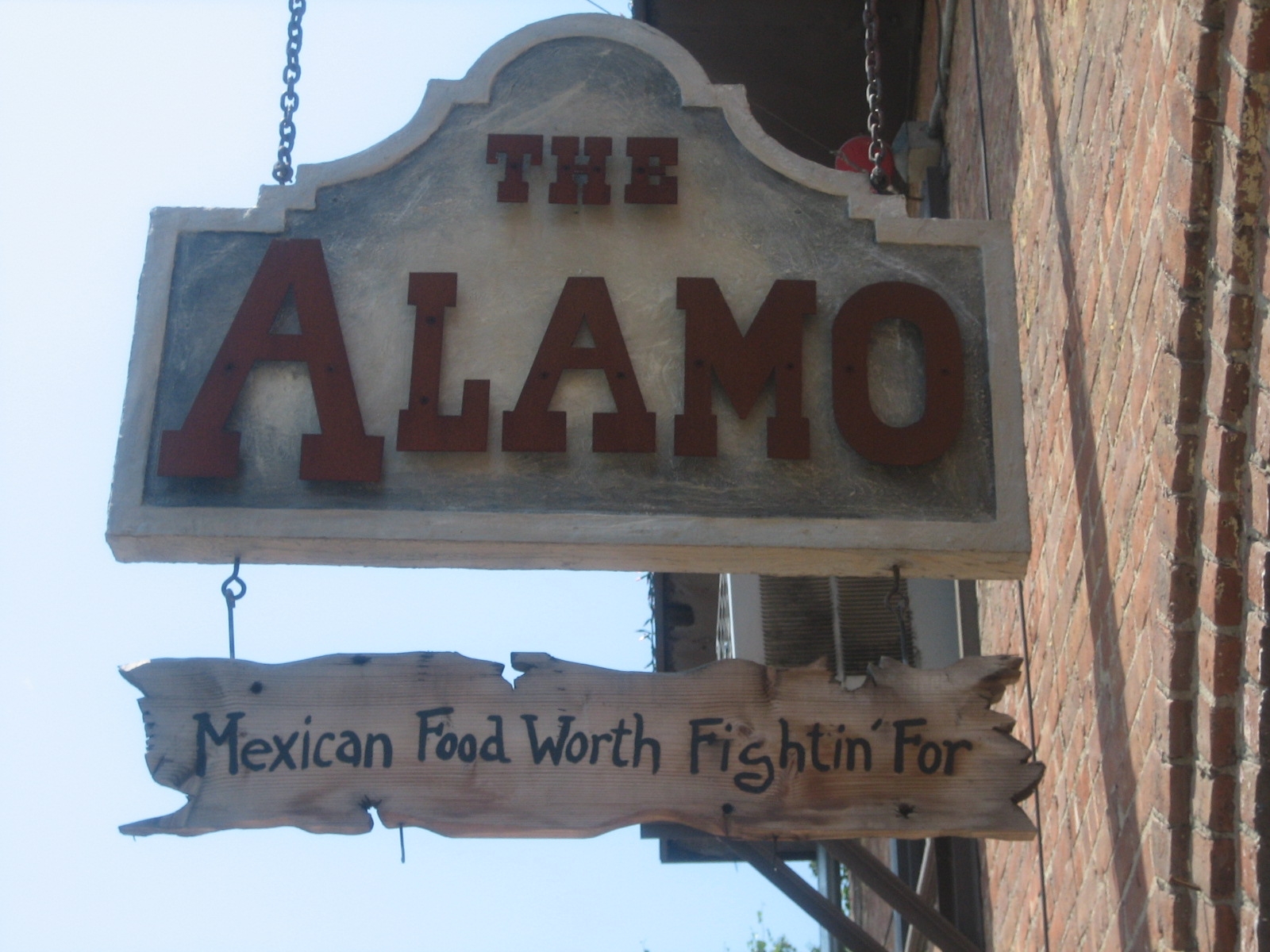
After all, if you want to try the real thing you’d better be ready to venture into grasshopper territory. Otherwise, you’ll be stuck with the usual tasteless Tex-Mex food, such as the one served at The Alamo (in the picture) whose owners at least have a sense of humor … and history! (Click on the picture to read the restaurant’s slogan)

P&G’s next marketing frontier: “la tiendita”

tiendita-de-don-pepe.jpg

Procter & Gamble has a big problem in Mexico: poor people and their insistence on buying things in small packets and in little tienditas –those small stores that refuse to disappear despite Wal-Mart’s best efforts.

An article in today’s Wall Street Journal tells us the story of Martina Perez, who makes 120 pesos a day ($11) sewing by hand, and who instead of buying a full-size bottle of Head & Shoulders shampoo, settles for a 0.34 ounce single-use packet which cost about 19 cents. (What is it with poor people and their shopping habits?)

But worry no more. According to the article, P&G has an army of marketing experts and researches who have spent the last 6 years working on how to deal with the popularity of over 600,000 tienditas, or as P&G likes to refer to them: “high-frequency stores.”

The result is a series of amusing marketing techniques that the consumer products giant is employing to stay ahead of the curve and convert elusive store owners:

– Lobbying for better shelf space: company personnel regularly visit the tienditas and offer to tidy the shelves

– The launch of specialized business magazine Tu negocio (Your business) targeting store owners (will they also teach them how to read? I wonder)

– Offer them management tips, such as how to calculate their profit margins

– Employ “reverse engineering” techniques: rather than create an item and then assign a price to it, P&G first consumers what consumers can afford and my personal favorite:

– Populate the ceilings: following a technique that P&G says has been a tremendous success in Asia, the idea is to have the most hanging products from the ceilings. Dangling items, “research shows” can catch shoppers attention more than products sitting on the shelves. “The ceiling is still a virgin location,” said a P&G executive.

Got pesos? Go shopping in Texas

45pesosl.jpg

Got some cash left over from your last Spring break in Cancún? Go shopping in Dallas! they will happily take your pesos.

Only a few months after Pizza Patrón announced it would accept Mexican pesos as payment, another Dallas-based retailer has followed suit. Value Giant is now taking pesos as payment in all of its stores and to kick off the promotion, this weekend launched a promotional event in one of its stores to introduce the new policy, according to a local Fox affiliate.

Maybe my fellow Mexicans will want to reconsider all the trouble they go through to get here and earn those coveted greens: why bother, I mean, if they can now get their pizzas and their groceries in pesos.

Ah, the wonders of globalization!

Gays are not normal people: Niurka Marcos

bobby_niurka_72606.jpg

The increasingly powerful Gay & Lesbian Alliance Against Defamation (GLAAD) this week condemned telenovela actress Niurka Marcos’ use of defamatory anti-gay comments during interviews aired last week on Univision, Televisa, Telefutura, Telemundo and Azteca América.

In an interview with a popular Mexico City-based gossip show, the Cuban vedette simply said about her former husband: “I don’t know what he did with his body, his soul, his feelings.  At that time when I left him, he was normal.”

As it turns out, Niurka’s former man, Bobby Larios is starring in Descarados, a play in which he will portray a gay man who struggles with his sexual orientation before finally coming out to his friends.

This is by no means the first time GLAAD  comes out after Spanish-language media. The organization has been behind some of the most successful efforts to “educate” U.S.-based Hispanic TV anchors about their use –and misuse– of derogatory terms (i.e. mariquita) widely used in hugely popular shows such as Cristina, Don Francisco, El Chavo del Ocho, etc.

Ready to unleash my enchanting side

There’s gotta be something wrong with me because, as a Hispanic woman, I don’t seem to know how to unleash my mysterious, enchanting side through passion and romance.

But that might change soon, thanks to Univision’s new telenovela, Mi adorada Malena, which debuts tonight at 6:00 PM (ET) and follows the comings and goings of Malena Ferreira, a professional, “strong, beautiful and exotic woman,” and two caballeros vying for her attention.

But don’t expect your typical one-hour Televisa-produced drama: Mi adorada Malena is a Univision production and will only be available on the Internet.

Oh, and I almost forgot to mention: the protagonista also happens to be a spokesperson for Caress Exotic Oil Infusions body wash. And in fact the body wash itself is a key element to the plot. And why not? after all, the six-episode series is nothing but a big product pitch by the Unilever brand.

In explaining the cultural insight behind the effort, a marketing director at Unilever simply said in a statement that “Hispanic women know how to unleash their mysterious, enchanting sides through passion and romance.”

Do we really? maybe I’ve been using the wrong moisturizing (or is it body wash?)

¡Cuidado!: Bad translation ahead

New York City is a cosmopolitan city. So much so that both public and private enterprises work hard every day to make sure the city’s growing Hispanic population understands what’s going on.

And that is why the people in charge of a Linmar Construction site in Manhattan’s West 25th street, made sure to translate every word of a presumably important notice for the Spanish speaking crowd. The sign reads as follows:

img_0003.jpg

Confused? Well, it’s not that hard if you speak a little English or at least have a good imagination to make up for the missing words, verbs and adjectives. Try a little, and you will eventually figure something out. Otherwise, check out the English version (below) to see what you’ve been missing.

I wonder if this is a truly a case of poor translation work or a Maquiavelic way to intentionally confuse Latinos and avoid having them complaining (oops! shall I say reporting?) about unsafe working conditions? you never know! (photos: Mariana Carreño King)

img_0002.jpg

Who wants to be the ‘mero mero drywalero’?

construction.jpg

I had no idea what a dry wall “expert” (or drywalero) was. But thanks to a Chicago-based company I now know that is someone who works with drywalls and is eligible for a $5,000 cash award courtesy of Sheetrock, a USG corporation that specializes in, well, dry walls.

And following the example of other “innovative” marketers, this firm is going the extra mile in reaching the Hispanic consumer. Just check out this week’s announcement by Sheetrock with a call for entries looking for the “mero mero drywalero.”

The competition is about identifying -and crowning- “el mero mero drywalero,” loosely translated as the “Best of the Best Drywaller” in Chicago. The first prize is $5,000 in cash. The company has even set up a dedicated Web site with Brazilian-like music included (don’t ask why) luring Mexican-looking guys to apply.

Contest rules call for applicants to be at least 21 years of age, though there is no word of immigration status, which makes me think ‘my people’ are more than qualified for the prize.

Other skills required (verbatim):

  1. Contestants will snap and score a Sheetrock Brand gypsum wallboard panel along pre-marked lines.
  2. Contestants will then hang the panel on a stud wall structure furnished by USG using 5 drywall screws and a screw gun supplied by USG. Screws must be at least 2 inches apart from each other. (note: Mexican workers will have to be familiar with the inch dilemma).
  3. Using a new Sheetrock Brand knife, Contestants will dispense Plus 3TM Joint Treatment Compound into a pan and mix three times. Water will be already placed in the pan.
  4. Contestants will apply the Plus 3TM Joint Treatment Compound to the panel to cover the 5 screws.
  5. Contestants will then place the knife in the pan and put the pan back on the floor.
  6. The winner of each round will be the contestant with the fastest time; however, deductions of 5 seconds will be taken for each of the following:
    • dropping more than a teaspoon of compound on the floor
    • overdriving more than one screw
    • failing to cover a screw with joint compound
  7. Failure to wear any PPE item will disqualify a contestant

Piece of cake!

I’m sure my fellow Mexicans will do better here than in their previous challenge (playing the U.S. national soccer team) which didn’t turn out that peachy.

Si se puede!!

P&G’s latest finding: Latinos love to smell

chimp-smell-roses.jpg

You may not know this, but we Hispanics are “avid scent seekers.”

That is according to Procter & Gamble, which worked closely with “smell expert” Dr. Alan Hirsch in determining the impact of scents in Latinos’ moods. The result of such exhaustive research is a partnership with Target stores, announced this week, to “Inspire the living environments of Hispanic consumers with scent tips”

I’m not sure exactly what that means but it smells like a plot to push Tide, Febreze, Bounce, Cascade and Downy among “my people.” Funnily enough, after reading the release to my mom (the ultimate Latino housewife) she emphatically said “That’s not true!… I use Clorox all the time, y huele a rayos!”

Procter & Gamble’s “insight” reminded me of that of Coor’s, which recently found out we Latinos are particularly sensitive to “cold” when it comes to drinking beer (“Latinos like it cold”). Or WebMama.com Inc., the search engine marketing company that recently stumbled upon another unprecedented finding: “Hispanics in the U.S. are more comfortable with technology than the general population.”

(Why on earth didn’t I get into marketing? sounds like easy, fun, full of B.S. and certainly better paid than journalism!)

One (Latino) nation under dog

chihuahua1.jpg

Latino film lovers brace yourselves! The Walt Disney Co. next year will bring you South of the Border, featuring, among many others, Salma Hayek, Andy García, Cheech Marin, Plácido Domingo, Edward James Olmos and even Univision radio personality Eddie “El Piolín” Sotelo.

But don’t expect anything too politically or socially charged. According to IMDB, the plot of South of the Border, currently in pre-production, can be resumed as follows: “While on vacation in Mexico, Chloe, a ritzy Beverly Hills chihuahua, finds herself lost and in need of assistance in order to get back home.”

Alas, none of the Latino luminaries mentioned above will be giving voice to the main character. The job, says The Hollywood Reporter has already been given to Drew Barrymore.

Ay Chihuahua!

War troubles? try sweetening them up with Splenda

Spanish-language media in the U.S. have never been very good at news analysis; let alone at taking a stand for -or against- issues other than immigration. But when it comes to pairing products and services with heart-wrenching, novela-like programming, Hispanic television is an indisputable leader.

Take the Iraq war and last night’s Soñando Contigo one-hour special on Univision.

Producers of the show brought in U.S. Army Sgt. Rogelio Paredes before being shipped out for his third tour of duty in Iraq. The occasion? to renew his wedding vows on national television, and in front of a live audience. All of this, of course, was made possible by Univision and Splenda … Yep, as in the non-sugar sweetener made by McNeil Nutritionals.

In addition to the public ceremony, Sgt. Paredes’ received a “fantasy getaway” for his immediate family in -where else?- Las Vegas; and to top it all of: a lavish wedding cake sweetened with -what else?- Splenda.

How sweet is that?

I did see the show but in case you missed it, you can read the details in an incredibly long press release.

Corona drinkers of the world, beware!

Can you tell the difference between these two bottles?

It took me a while, actually. But it turns out the Chinese are producing -and exporting- Cerono beer, which looks and feels exactly like Grupo Modelo’s Corona beer. (Of course, the real one is quite tasteless but that’s not the point here).

Mexican anti-piracy authorities are fuming over Beijing-based Beijing Cerono Trade Limited Company, which last year sold more than one million cases of Cerono worldwide.

The problem does not stop there. The Chinese apparently have also come up with their own brand of “tequila” called Platinum Tequila Infusión, which is also being exported to the United States with the label “Made in Mexico.”